
Laser Treatments in Richmond, BC: Why the Right Technology Matters
Not all laser treatments are the same. Learn how skin type, hair characteristics, treatment goals, wavelength, and technology selection help shape a personalized treatment plan at Profile Laser & SkinCare in Richmond, BC.
5 min read
Quick answer
The right laser treatment depends on your skin type, hair or pigmentation characteristics, treatment area, and goals. Different wavelengths and technologies target tissue differently. At Profile Laser & SkinCare in Richmond, BC, access to multiple laser and aesthetic platforms allows treatment recommendations to be personalized rather than relying on one device for every client.
Key takeaways
- 01Different laser wavelengths are suited to different skin, hair and treatment characteristics.
- 02Common hair-removal wavelengths include 755 nm, 810 nm and 1064 nm.
- 03Some platforms combine multiple wavelengths to broaden treatment options.
- 04Not every aesthetic technology is a laser; radiofrequency, ultrasound and RF microneedling have different roles.
- 05Consultation helps determine whether one treatment or a planned sequence of treatments is most appropriate.
Choosing laser treatment can be confusing. One clinic in Richmond, BC, may recommend one type of laser; another may suggest radiofrequency or ultrasound, and online searches can make every technology sound like the perfect solution.
The reality is more nuanced. Choose laser treatments in Richmond, BC, based on the individual—not simply on which machine is available.
At Profile Laser & SkinCare, we match the technology to the client’s skin type, hair characteristics, concerns, treatment area, comfort level, and goals. After more than four decades serving Richmond and Greater Vancouver, we have learned that aesthetic care is rarely one-size-fits-all.
Why aren’t all laser treatments the same?
The word "laser" describes a broad family of technologies. Different systems use different wavelengths, pulse durations, energy levels, delivery methods, and cooling systems.
These differences matter because various wavelengths interact differently with targets such as
- melanin in unwanted hair
- pigmentation in the skin
- tattoo pigment
- water within skin tissue
- vascular structures
- deeper tissue involved in rejuvenation or remodeling
Health Canada notes that the effectiveness and potential risks of cosmetic laser procedures depend on several factors, including the device chosen, wavelength, treatment settings, operator training, and the client’s skin and hair color. Canada
That is one reason consultation and technology selection are so important.
Why does Profile use several technologies for laser hair removal?
Laser hair removal is a particularly relevant example of why having access to different technologies can be valuable.
Common hair-removal wavelengths include - 755 nm Alexandrite
- 810 nm diode laser
- 1064 nm NdYAG
Published reviews describe these wavelengths as established approaches for long-term hair reduction, with their characteristics making them more or less suitable depending on skin pigmentation, hair characteristics, and treatment parameters.
Some newer systems can also combine multiple wavelengths within a single platform. Research has evaluated triple-wavelength systems combining 755, 810, and 1064 nm for hair reduction across a range of skin types.
At Profile, this issue matters because our technology portfolio includes platforms such as Alma Soprano Titanium, Cynosure Elite iQ, InMode Triton, InMode Diolaze, Cynosure Vectus, and Fotona for selected applications.
The goal is not to decide that one laser is universally “best.” The goal is to have enough options to select an appropriate approach for the person in front of us.
How do we choose the right laser treatment?
Consider several factors before treatment.
- Skin type and pigmentation
The amount of melanin in the skin influences how laser energy is absorbed. This is especially important when treating darker or recently tanned skin.
Longer wavelengths, such as 1064 nm NdYAG, have lower epidermal melanin absorption than shorter wavelengths and are often used for more deeply pigmented skin types. - Hair color, thickness, and depth
Coarse, dark hair behaves differently from finer or lighter hair. Facial hair may also require a different strategy than hair on the legs, back, bikini area, or underarms.
This is one reason access to 755 nm, diode-range wavelengths, and 1064 nm technology can broaden treatment options. - The condition being treated
Hair removal, pigmentation, acne scars, and skin rejuvenation are fundamentally different concerns.
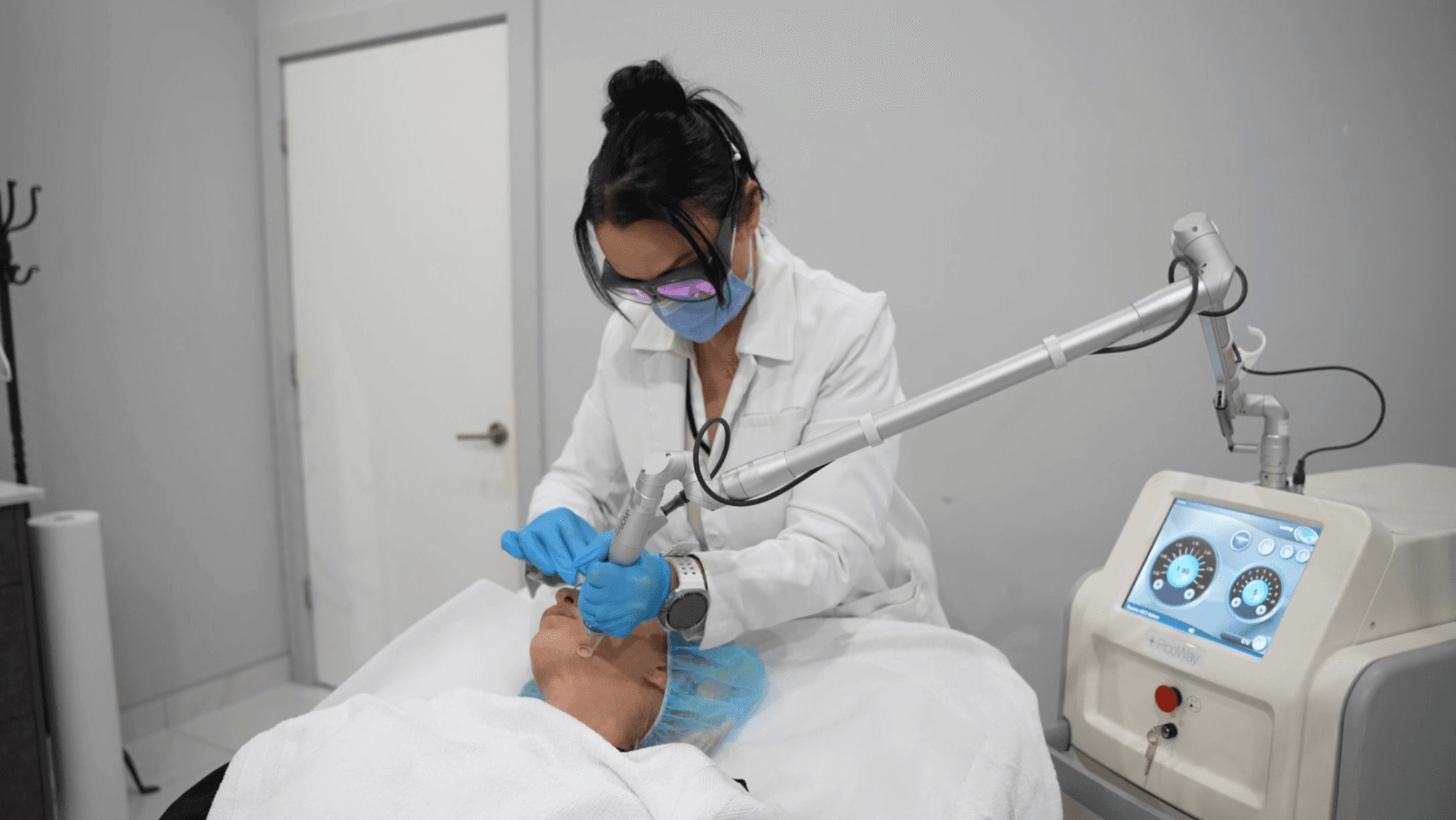
For example, technologies such as PicoWay may be considered for selected pigmentation, tattoo, and skin-rejuvenation applications, while Fotona SP Dynamis can support a broader range of laser protocols.
The device should follow the treatment objective—not the other way around. - Previous treatments and skin response
A consultation should also consider previous laser treatments, medications, sun exposure, pigmentation changes, sensitivity, and how the skin has responded to previous procedures. - Downtime and personal preference
Two clients with a similar concern may still choose different treatments because one prefers minimal downtime while another is comfortable with a more intensive treatment and recovery period.
What about treatments that are not lasers?
Another common misconception is that every advanced aesthetic device is a laser.
It is not.
Profile also uses technologies based on radiofrequency, focused ultrasound, RF microneedling, thermo-mechanical treatment, advanced facial systems, and AI-assisted skin analysis.
For example:
- Thermage FLX uses radiofrequency.
- Ultherapy uses focused ultrasound.
- Morpheus8 uses fractional RF microneedling.
- Tixel uses thermo-mechanical technology.
- HydraFacial, Bela MD+, JetPeel and OxyGeneo provide different facial-treatment approaches.
This is why the question we prefer to answer is not simply “Which machine is best?”
It is:
Which treatment is most appropriate for my concern?
That answer begins with identifying the concern accurately.
Someone seeking unwanted-hair reduction has very different needs from someone concerned about facial laxity, acne scars, pigmentation, dehydration, or uneven texture.
At Profile, the Meicet Pro-A AI Skin Analyzer can also support the consultation by assessing characteristics such as hydration, oiliness, pores, pigmentation, redness, and texture. AI skin analysis supports consultation and treatment planning; it does not replace medical diagnosis.
From there, we can discuss whether one treatment—or sometimes a carefully planned sequence of treatments—is appropriate.
Can different technologies be combined?
Sometimes, yes.
A personalized aesthetic plan may use different technologies over time because each addresses a different component of the concern.
For example, a rejuvenation plan might incorporate:
- a technology targeting skin tightening;
- another approach addressing texture or pigmentation;
- professional facial treatments for hydration and maintenance; and
- medical-grade skincare and daily sun protection.
However, treatments are not automatically combined. Timing, skin condition, treatment intensity, and recovery requirements all need to be considered.
Why consultation matters
Technology continues to advance quickly, but more devices only matter if you choose them thoughtfully.
Health Canada advises consumers considering cosmetic laser procedures to investigate whether they are suitable candidates, understand potential risks and recovery requirements, and ensure the person operating the device has appropriate training and experience. Canada
That philosophy aligns closely with Profile Laser & SkinCare's approach in Richmond, BC.
Our goal is to combine advanced technology, personalized care, experienced client-centered treatment planning, and more than four decades of serving Richmond.
Advanced technology. Personalized care. Results you can trust.
FAQ
Frequently asked questions
01What laser is best for hair removal?
No single laser is best for everyone. The most appropriate technology depends on factors including skin tone, hair color and thickness, treatment area, and previous response to treatment.
02Why does Profile Laser & SkinCare have several laser systems?
Different wavelengths and devices have different characteristics. Having multiple platforms allows Profile to select treatment based on the individual client rather than using the same technology for everyone.
03What do 755 nm, 810 nm and 1064 nm mean?
These numbers represent laser wavelengths. They differ in how deeply the energy penetrates and how strongly it interacts with melanin in the skin and hair, which influences treatment selection.
04Can darker skin tones have laser hair removal?
Yes, many darker skin types can be treated. Device selection, wavelength, treatment parameters, and operator experience are particularly important. Longer-wavelength 1064 nm Nd:YAG systems are commonly used for more deeply pigmented skin types.
05Do I need a consultation before laser treatment?
A consultation is recommended before most laser treatments. It allows the provider to review your skin type, concern, treatment history, expectations, and suitability before recommending a technology or treatment plan.
06Can different aesthetic technologies be combined?
Yes, you can combine or sequence selected treatments when appropriate. Timing depends on the technologies involved, the required recovery time, the condition being treated, and skin response.