
· Updated
Body Contouring in Richmond BC: Which Technology Fits Your Goal?
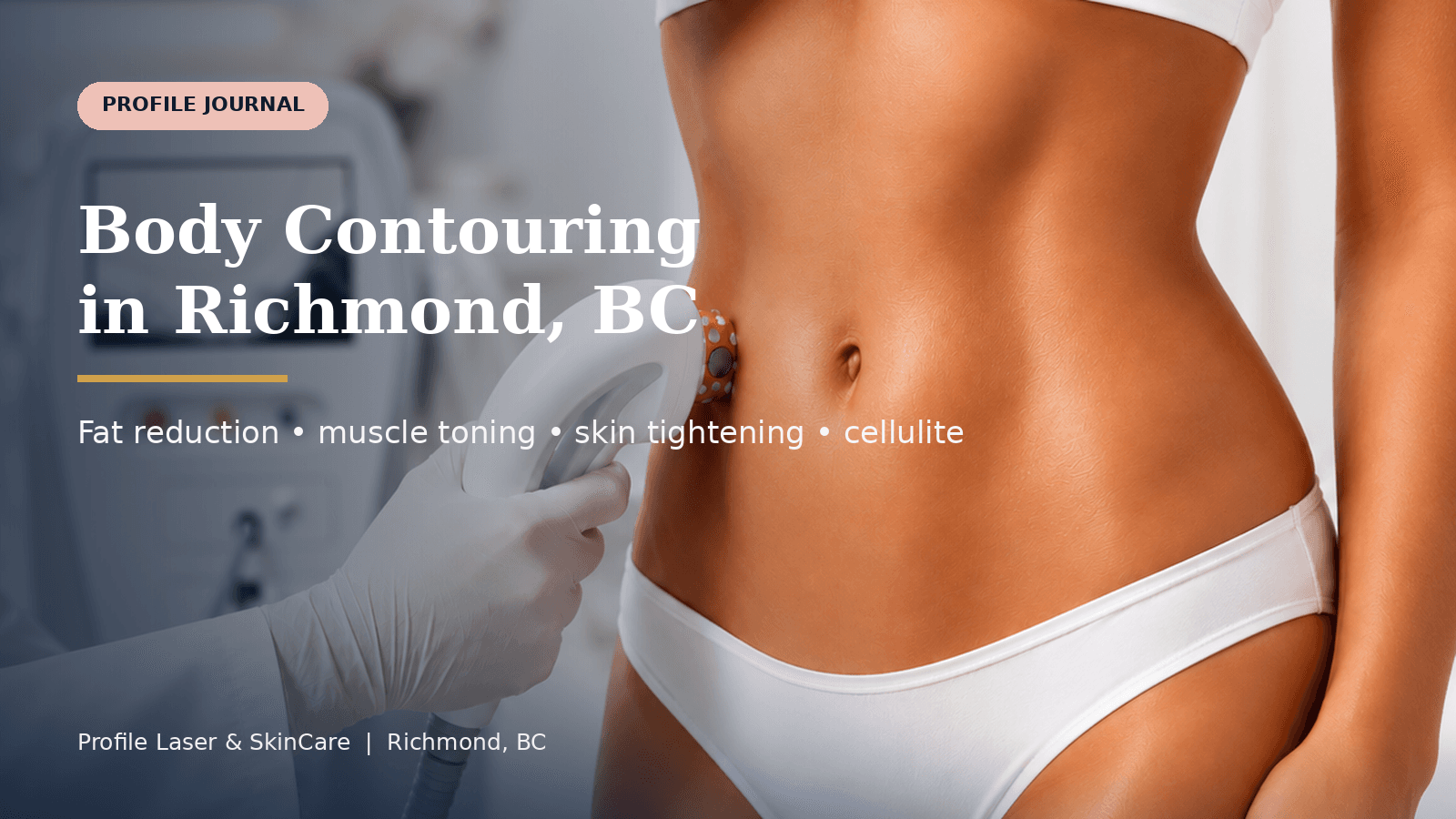
Non-surgical body contouring can mean fat reduction, muscle toning, skin tightening, or cellulite improvement. Learn how Profile Laser & SkinCare in Richmond, BC, uses different technologies to match treatments to each person's goals.
8 min read
Quick answer
Non-surgical body contouring can address different goals, including localized fat reduction, muscle toning, skin tightening, and cellulite. At Profile Laser & SkinCare in Richmond, BC, we select technologies such as Accent Prime, truSculpt iD, truSculpt flex, BodyFX, and SculpSure based on the treatment area, tissue characteristics, and individual goals.
Key takeaways
- 01Takeaway 1: Body contouring is not a weight-loss treatment; it is intended to address specific areas and aesthetic concerns.
- 02akeaway 2 Fat reduction, muscle toning, skin tightening and cellulite are different treatment goals and may require different technologies.
- 03Takeaway 3 Accent Prime combines ultrasound and radiofrequency, while truSculpt uses RF-based body sculpting.
- 04Takeaway 4 truSculpt flex focuses on muscle stimulation and toning, while SculpSure uses a 1060 nm laser for selected localized fat concerns.
- 05Takeaway 5 Having multiple technologies allows Profile Laser & SkinCare to personalize treatment rather than using one device for every client.
Non-surgical body contouring in Richmond, BC is no longer a single type of treatment. Today, different technologies can address very different goals, including localized fat reduction, muscle toning, skin tightening, body shaping, and the appearance of cellulite.
At Profile Laser & SkinCare in Richmond, BC, we believe treatment should begin with the concern, not the machine. Our current body-contouring technologies include Alma Accent Prime, truSculpt iD, truSculpt flex, InMode BodyFX, and SculpSure. Each works differently, which allows treatment planning to be based on the individual client, treatment area, tissue characteristics, and desired outcome.
What does non-surgical body contouring actually do?
Body contouring, sometimes called body sculpting, is a broad term.
The U.S. Food and Drug Administration describes non-invasive body contouring as procedures that may be used to change the circumference or silhouette of an area, reduce small areas of fat, improve muscle tone or firmness, or improve the appearance of cellulite.
An important distinction is that body contouring is not a weight-loss treatment and is not intended to treat obesity.
That is why the first question shouldn't be “Which machine is best?”
A better question is
What are we trying to improve?
For one person, the primary concern may be a localized pocket of fat. Another may want better abdominal or gluteal muscle definition. Someone else may be more concerned about loose skin, cellulite, or a combination of these factors.
Those goals require different approaches.
How do we choose body contouring in Richmond BC?
At Profile Laser & SkinCare, we begin by identifying the main concern and examining the treatment area.
Factors that may influence treatment selection include:
- whether the main concern is localized fat, muscle tone, skin laxity or cellulite
- the size and location of the treatment area
- skin and tissue characteristics
- previous treatments
- medical history and contraindications
- comfort and downtime preferences
- realistic treatment goals
- whether one technology or a planned sequence of treatments makes more sense
Having several technologies is valuable because it means we do not have to make one device fit every client.
Alma Accent Prime: ultrasound and radiofrequency in one platform
Alma Accent Prime combines ultrasound and radiofrequency technologies for body and face contouring.
Alma describes its guided ultrasound technology as targeting adipose tissue, while its radiofrequency technology provides controlled heating at different tissue depths and supports collagen remodeling and skin tightening.
Its RF technology operates at 40.68 MHz, while different applicators allow treatment of small and larger areas.
This makes Accent Prime particularly interesting when a concern involves more than one component, such as localized fullness together with skin laxity or cellulite.
At Profile, Accent Prime may be considered for suitable areas such as the abdomen, thighs, flanks and other body regions following consultation.
truSculpt iD: radiofrequency body sculpting
truSculpt iD is part of Cutera's radiofrequency body-sculpting technology.
The truSculpt platform uses monopolar radiofrequency energy to heat the subcutaneous fat layer and is designed for non-invasive body contouring.
Cutera reports an average 24% fat reduction in the treated area in its supporting clinical data. That figure represents an average reported in manufacturer-supported data, not a guaranteed result for an individual client.
The important point is that truSculpt iD is primarily relevant when localized fat reduction and body contouring are the treatment goals.
truSculpt flex: when muscle tone is the goal
truSculpt flex has a very different purpose.
Rather than primarily targeting fat, truSculpt flex uses multi-directional electrical muscle stimulation to produce repeated muscle contractions.
Cutera lists applications including strengthening, toning and firming of the abdomen, obliques, glutes and thighs. Current truFlex treatments can be performed in approximately 15 minutes, depending on the protocol.
This distinction matters.
A client whose primary concern is reduced muscle definition may require a different approach from someone whose main concern is a localized fat pocket.
In some clients, both factors contribute to body shape. Treatment planning can then consider the different components separately.
InMode BodyFX: RF, vacuum and tissue contouring
InMode BodyFX combines bipolar radiofrequency energy with vacuum-assisted tissue treatment.
Published research describing the BodyFX platform reports that vacuum draws tissue between the RF electrodes while controlled RF energy heats the skin and underlying adipose tissue. The technology is intended to support body contouring while also addressing tissue and skin characteristics.
At Profile, BodyFX may be considered when concerns include localized fullness, cellulite, tissue texture or skin-tightening support.
Again, this illustrates why the term body contouring cannot describe every technology in exactly the same way.
SculpSure: 1060 nm laser body contouring
SculpSure approaches body contouring differently.
Instead of radiofrequency or muscle stimulation, SculpSure uses a 1060 nm diode laser to heat targeted adipose tissue.
The manufacturer describes body-treatment sessions of approximately 25 minutes, with changes beginning to become visible from around 6 weeks and optimal results commonly assessed around 12 weeks after treatment. Individual results vary.
SculpSure can therefore be considered when the principal goal is non-surgical reduction of selected areas of localized fat.
It is not intended as a substitute for weight loss.
Is one body-contouring technology better than another?
Not universally.
The best technology is the one that appropriately matches the tissue, concern and treatment goal.
For example:
- Localized fat may lead us to discuss technologies designed primarily for fat reduction.
- Muscle tone and definition may lead to a muscle-stimulation approach such as truSculpt flex.
- Skin laxity may require greater emphasis on radiofrequency or another tightening technology.
- Cellulite or uneven tissue texture may require a different strategy again.
- Mixed concerns may benefit from a carefully planned sequence rather than expecting one technology to address everything.
The availability of multiple platforms allows us to have that conversation before deciding on treatment.
Can different body-contouring treatments be combined?
Yes, in selected clients different technologies may be combined or sequenced when appropriate.
For example, a treatment plan might address localized fat first, followed by muscle toning when improved definition is also desired. Skin-tightening treatment may be considered separately when laxity contributes to the appearance of an area.
“Combination treatment” does not necessarily mean performing everything during the same appointment.
Treatment spacing depends on the technologies involved, tissue response, treatment intensity, recovery requirements and individual goals.
Is non-surgical body contouring the same as weight loss?
No.
This is one of the most important distinctions for clients to understand.
According to the U.S. Food and Drug Administration, non-invasive body-contouring procedures do not treat obesity, do not produce meaningful overall weight loss, and do not provide the health benefits associated with weight loss.
They are better suited to appropriately selected clients seeking improvement in particular areas of the body.
Healthy lifestyle habits remain important for maintaining body composition and treatment results.
Is non-surgical body contouring safe?
Body-contouring technologies are non-surgical, but they are still energy-based aesthetic procedures with benefits, limitations, contraindications and possible side effects.
The FDA notes that temporary effects across body-contouring technologies may include discomfort, redness, swelling, bruising or palpable nodules. Specific risks vary according to whether the technology uses radiofrequency, ultrasound, laser energy, muscle stimulation or another mechanism.
This is why clients should disclose relevant medical history, medications, pregnancy status, implanted electronic or metallic devices, previous surgery in the treatment area and other health factors during consultation.
Not every technology is appropriate for every person.
What happens during a body-contouring consultation?
At Profile Laser & SkinCare in Richmond, BC, we begin by asking what you actually want to change.
We then assess whether the concern appears primarily related to:
- localized fat
- reduced muscle tone
- skin laxity
- cellulite or uneven texture
- or a combination of these factors
From there, we can discuss the technologies that may be appropriate, how each treatment works, expected treatment timing, potential limitations, and whether a single technology or a planned sequence makes more sense.
The objective is not simply to use the newest machine. It is to select an approach that makes sense for the individual client.
Something new is coming to Profile
Our technology portfolio continues to evolve.
While this article focuses on body contouring and sculpting, Profile has recently added a new advanced radiofrequency skin-tightening technology to our clinic.
We are deliberately holding back the full announcement while we prepare a special open-house introduction, where clients can learn about the technology, see how it works, and ask questions.
We will share the full details soon.
Consider this a small preview of what is coming next.
Why does technology choice matter?
No single body-contouring technology is ideal for every concern.
The value of having multiple technologies is the ability to distinguish between fat reduction, muscle stimulation, skin tightening, and cellulite-related concerns, then select treatment according to the actual goal.
At Profile Laser & SkinCare in Richmond, BC, our approach is based on personalized consultation, appropriate technology selection, realistic expectations, and decades of experience serving Richmond and Greater Vancouver.
Different goals. Different technologies. A treatment plan designed around you.
Sources and further reading
Medical Devices Active Licence Listing (MDALL): https://www.canada.ca/en/health-canada/services/drugs-health-products/medical-devices/licences/medical-devices-active-licence-listing.html?utm_source=chatgpt.com
For additional information, see the U.S. Food and Drug Administration guidance on non-invasive body contouring technologies, as well as manufacturer information from Alma Lasers, Cutera, InMode, and Cynosure regarding the technologies discussed above.
https://www.fda.gov/medical-devices/aesthetic-cosmetic-devices/non-invasive-body-contouring-technologies?utm_source=chatgpt.com
https://www.fda.gov/medical-devices/aesthetic-cosmetic-devices/non-invasive-body-contouring-technologies?utm_source=chatgpt.com
https://www.canada.ca/en/health-canada/services/healthy-living/your-health/medical-information/cosmetic-laser-treatments.html?utm_source=chatgpt.com
FAQ
Frequently asked questions
01What is the best body-contouring treatment?
No single body-contouring treatment works best for everyone. The most appropriate technology depends on whether the main concern is localized fat, muscle tone, skin laxity, cellulite, or a combination of these factors.
02Is body contouring the same as weight loss?
No. Non-surgical body contouring is designed to change the appearance or contour of selected areas. The FDA states that non-invasive body contouring is not intended to treat obesity or provide the health benefits associated with weight loss.
03What is the difference between truSculpt iD and truSculpt flex?
TrueSculpt iD is an RF-based body-sculpting treatment used primarily for localized fat and contouring. TrueSculpt Flex focuses on stimulating, strengthening, and toning muscles. Cutera lists the abdomen, obliques, glutes, and thighs among the muscle groups treated with TrueSculpt.
04What does Alma Accent Prime do?
Accent Prime combines ultrasound and radiofrequency technologies. Alma describes ultrasound as targeting adipose tissue, while RF delivers controlled heating at different tissue depths to support contouring, collagen remodeling, and skin tightening.
05How does SculpSure work?
SculpSure uses a 1060 nm laser wavelength to heat targeted adipose tissue during non-invasive body-contouring treatment. Cynosure describes approximately 25-minute treatment sessions, with results developing over the following weeks.
06Can body-contouring treatments be combined?
Yes. Different technologies may sometimes be combined or sequenced when appropriate. The treatment plan depends on the concern, treatment area, technologies involved, tissue response, and individual goals.
07How many body-contouring sessions will I need?
The number of sessions varies by technology, treatment area and goal. Some treatments may produce measurable changes after one session, while others are commonly performed as a series. Consultation is needed to establish an appropriate plan and realistic expectations.
08Is Profile adding a new body-contouring technology?
Profile has recently expanded its radiofrequency skin-tightening technology portfolio, but we are saving the full introduction for an upcoming open house. More information will be announced soon. I prefer that last wording over calling the new XERF system a body-contouring device. Cynosure's Canadian information currently describes XERF's approved indications around facial lines and wrinkles, eyebrow lifting, and facial and neck laxity, so the teaser should position it as an expansion of your skin-tightening portfolio, not as another fat-reduction system.